


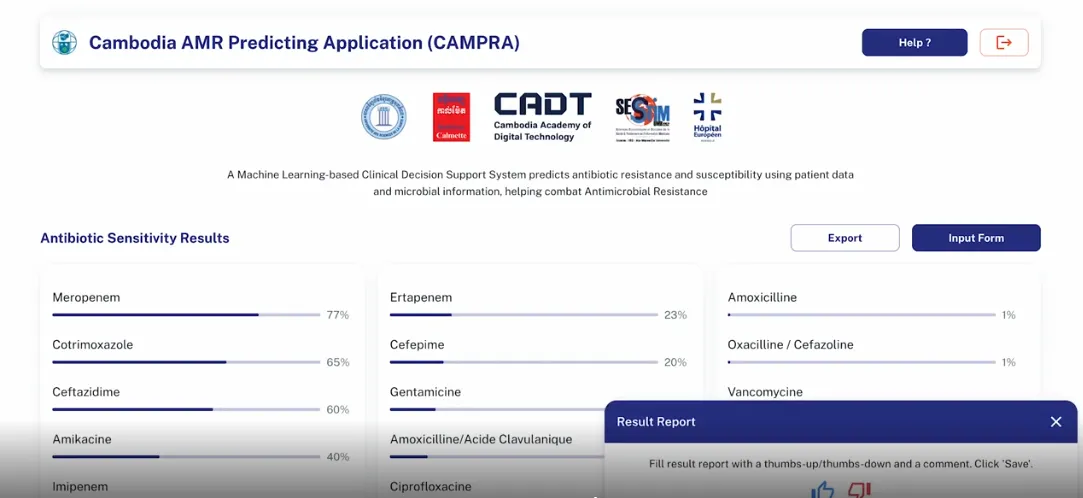
CAMPRA: Cambodia Antimicrobial Resistance (AMR) Predicting Application

Cambodia
Healthcare
Implementing Organisation
Cambodia Academy of Digital Technology
Cambodia, Pan-Country
Implementing Point of Contact
Thear Sophal
Researcher and Lecturer
Contributor of the Impact Story
Government of Cambodia
Year of implementation
2024
Problem statement
Antimicrobial resistance (AMR) is a growing public health challenge in Cambodia, driven in part by the inappropriate and delayed use of antibiotics. Healthcare professionals often rely on laboratory test results to guide treatment decisions, but these results are complex, time-consuming to interpret, and not always translated into clear, actionable guidance. As a result, doctors may prescribe antibiotics based on experience rather than evidence, increasing the risk of ineffective treatment, prolonged illness, and the spread of resistant bacteria.In resource-constrained healthcare settings, the lack of decision-support tools further limits the ability to use available data effectively. There is a critical need for a practical, easy-to-use system that can transform laboratory data into timely and understandable insights to support clinical decision-making. Without such tools, inappropriate antibiotic use will continue to undermine patient outcomes and weaken national efforts to control AMR. Addressing this gap is essential to improve the quality of care, optimise antibiotic use, and strengthen Cambodia’s response to Antimicrobial Resistance.
Submission Overview
The Cambodia Academy of Digital Technology (CADT) is a leading public research and education institution in Cambodia dedicated to building a vibrant, inclusive, and sustainable digital society. It aims to serve as the national flagship institution for digital technology and innovation by developing digital talent and nurturing innovators to support Cambodia’s digital transformation. CADT’s mission focuses on delivering high-quality higher education and professional training in digital technologies, advancing research and knowledge, and promoting innovation and entrepreneurship to improve academic and societal services. To achieve these goals, CADT operates through three institutes: the Institute of Digital Governance (IDG), which supports digital governance and provides digital skills training for civil servants; the Institute of Digital Technology (IDT), which offers specialised higher education programmes to develop digital innovators for the digital economy; and the Institute of Digital Research and Innovation (IDRI), Cambodia’s first dedicated digital research institute, leading R&D to drive digital innovation and entrepreneurship.
AI Technology Used
Key Outcomes
Efficiency & Productivity
Resource Efficiency
Cambodia Antimicrobial Resistance Predicting Application (CAMPRA) helps healthcare professionals in Cambodia make faster, evidence-based decisions about antibiotic prescriptions. The platform interprets laboratory resistance results and provides clear guidance on effective treatments. Early indicators show reduced inappropriate prescriptions, shorter time between lab results and correct treatment, better alignment between prescribed antibiotics and predicted effectiveness, and improved patient outcomes. The system also supports capacity-building by tracking trained users and sustained engagement over time.
Impact Metrics
Reduction in inappropriate antibiotic prescriptions
Baseline Value
Antibiotic prescriptions were frequently made based on experience rather than evidence, due to the complexity and time required to interpret laboratory resistance results
Post-Implementation
A reduction in inappropriate antibiotic prescriptions was observed post-implementation
Time from lab results to correct antibiotic prescription
Baseline Value
Laboratory results were complex and time-consuming to interpret, causing delays between results and treatment decisions
Post-Implementation
Average time between receiving laboratory results and prescribing the correct antibiotic was reduced
Alignment between prescribed and predicted effective treatments
Baseline Value
Doctors often prescribed antibiotics based on clinical experience rather than laboratory evidence, resulting in suboptimal treatment alignment
Post-Implementation
Increased alignment between prescribed treatments and predicted antibiotic effectiveness was observed
Patient treatment outcomes including treatment failure rates and antibiotic changes during care
Baseline Value
Resource-constrained healthcare settings lacked decision-support tools, limiting effective use of available data and increasing risk of ineffective treatment and prolonged illness
Post-Implementation
Improved patient outcomes were observed, including lower treatment failure rates and fewer changes in antibiotics during a course of care
Utilisation of laboratory data in clinical decision-making
Baseline Value
Clinical decisions were rarely informed by laboratory resistance data, as interpreting results was complex, time-consuming, and lacked systematic integration into prescribing workflows.
Post-Implementation
Increase in the percentage of clinical decisions that reference laboratory data within the system and improved monitoring of antimicrobial resistance patterns across healthcare facilities
Capacity-building and sustainability of the solution
Baseline Value
No formal training infrastructure existed for AI-assisted antimicrobial decision-making, and system adoption depended entirely on individual clinician initiative without institutional support.
Post-Implementation
Number of trained users, frequency of system use, and continued engagement over time
Implementation Context
Phnom Penh, Cambodia, and parts of South-east Asia
Cambodian citizens
Key Partnerships
University of Health Sciences, Calmette Hospital, SESSTIM/INSERM/IRD/AMU, Hôpital Européen Marseille, French Fonds de Solidarité des Projets Innovants through the French Embassy in Cambodia
Replicability & Adaptation
- For use in other contexts, the system should be adapted to local clinical guidelines, antibiotic formularies, and resistance thresholds.
- Integration with existing laboratory information systems may vary by country.
- Language localisation, user training, and alignment with national AMR policies are recommended to ensure effective adoption and sustainability
- Web Development Team
- Data Science Team
- An Expert in Antimicrobial Resistance
Supporting Materials

* The data presented is self-reported by the respective organisations. Readers should consult the original sources for further details.