


DeHaat: AI-Driven Crop Intelligence for Crop Planning and Advisory

India
Agriculture
Implementing Organisation
Green Agrevolution Private Limited (DeHaat)
India, Rajasthan, Multiple districts across major agricultural regions
Implementing Point of Contact
Nikhil Toshniwal
Chief Digital Officer
Contributor of the Impact Story
Government of Maharashtra’s AI and Agritech Innovation Center, World Bank Group, Wadhwani AI
Year of implementation
2024
Problem statement
Smallholder farmers in India increasingly face climate volatility, pest outbreaks, and rising input costs, while most advisory systems remain generic, reactive, and weakly linked to real field conditions. Traditional agricultural extension delivers one-size-fits-all advisories that are not crop-stage specific, not aligned with imminent weather risks, and difficult to operationalise. Frontline actors such as retailers, field officers, and calling teams lack real-time visibility into regional crop conditions, limiting timely and coordinated interventions. This disconnect between advisory content and ground reality undermines the effectiveness of agricultural extension, leading to inappropriate input application, delayed pest management, and missed opportunities for preventive interventions. The challenge is to institutionalise smart farming and intelligent crop planning through regionally contextualised agronomic intelligence that operates as a continuous service rather than standalone messages or seasonal campaigns.
Submission Overview
Green Agrevolution Private Limited (operating as DeHaat) is an Indian agri-tech company that has institutionalised AI-driven regional crop intelligence to transform agricultural advisory from generic, reactive messaging into a continuous, regionally contextualised service. Operating across major agricultural regions of India, DeHaat addresses the fundamental challenge faced by smallholder farmers: climate volatility, pest outbreaks, and rising input costs compounded by advisory systems that remain weakly linked to real field conditions.
AI Technology Used
Natural Language Processing, Remote Sensing Analytics
Key Outcomes
Access & Reach
Inclusion & Equity
Efficiency & Productivity
User Experience & Satisfaction
Resilience & Risk Reduction
Resource Efficiency
DeHaat's AI-driven regional crop intelligence platform is transforming agricultural advisory for 10.6 million smallholder farmers across India by replacing generic extension services with continuous, regionally contextualised decision support. By integrating satellite-derived crop health signals, hyperlocal weather forecasts, soil health data, and 200,000-300,000 monthly farmer diagnostics into a guardrailed agronomic intelligence layer, the platform generates over 26 million advisory sessions monthly with crop-stage and region-specific recommendations. The system has enabled earlier detection of 1.42 million pest and disease outbreaks over 12 months, shifted advisory from reactive to proactive prevention, and reduced inappropriate input application through context-aware guidance. Delivered through multichannel touchpoints with multilingual support, DeHaat demonstrates that responsible AI, when tightly coupled with agronomic science and embedded in trusted delivery channels, can institutionalise smart farming at scale and provide a replicable blueprint for transforming agricultural extension across emerging economies.
Impact Metrics
Number of farmers registered and accessing advisory services through AgriCentral platform
Baseline Value
Limited access to regionally contextualised advisory Farmers
Post-Implementation
10.6 million+ registered (6.4 million+ geo-mapped)
Pest and disease detections enabling regional outbreak analysis
Baseline Value
Reactive, farmer-reported incidents Detections
Post-Implementation
1.42 million detections (12 months)
Multilingual delivery ensuring accessibility for smallholders and first-time digital users
Baseline Value
Limited language accessibility Qualitative
Post-Implementation
Full multilingual support enabled Qualitative
Monthly advisory sessions generated across all channels
Baseline Value
Generic, seasonal advisory campaigns Sessions
Post-Implementation
26 million+ monthly sessions
Monthly farmer-sourced crop diagnostics processed
Baseline Value
Limited diagnostic capability Diagnostics
Post-Implementation
200 ,000-300,000 diagnostics/month
Implementation Context
Deployed across major agricultural regions of India
10.6 million registered smallholder farmers (6.4 million actively geo-mapped), frontline extension workers and agri-retail operators, and programme and operations teams
Key Partnerships
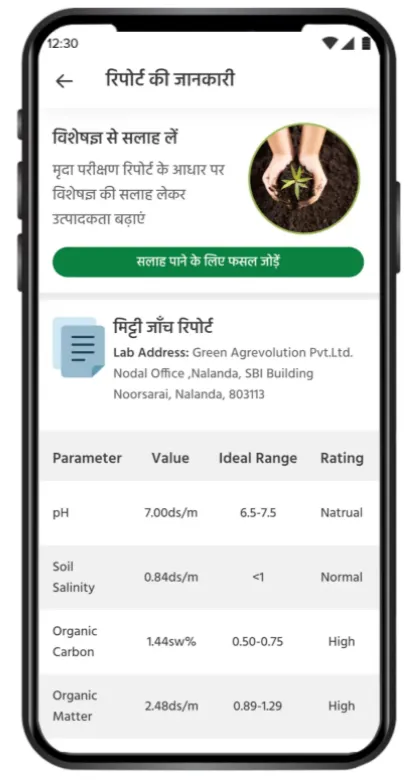
Soil Health Card programme, Government of India
Replicability & Adaptation
- Satellite remote sensing and weather APIs, cloud computing infrastructure, mobile platform, GIS tools; AI/ML engineers, agronomists, data scientists, field teams
- Platform development capital, operational costs for data and infrastructure, field operations and farmer engagement, ongoing maintenance
- Agricultural research institutions, government agencies for data access, retail networks, farmer cooperative structures
Supporting Materials

* The data presented is self-reported by the respective organisations. Readers should consult the original sources for further details.