


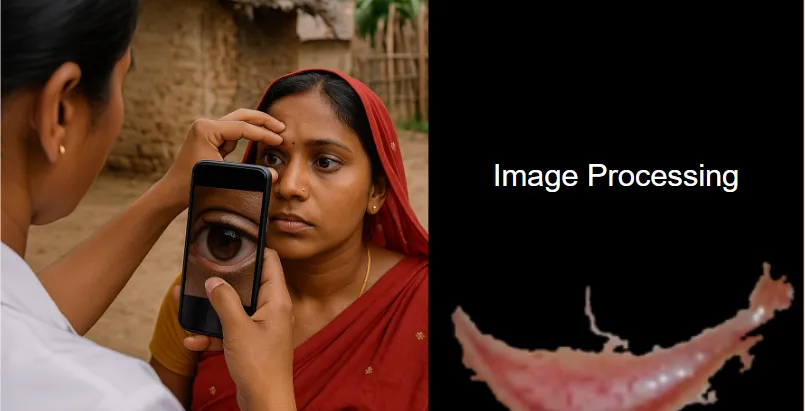
MAHILA: Smartphone-Based AI Screening for Maternal Anemia Using Eye and Tongue Images

India
Healthcare
Implementing Organisation
Khushi Baby
India, Rajasthan, Udaipur
Implementing Point of Contact
Saket Kumar
R&D Lead
Contributor of the Impact Story
Carnegie India
Year of implementation
2024
Problem statement
Affecting an estimated 12 million pregnant women annually in India, maternal anemia is a major contributor to adverse maternal and neonatal outcomes, yet screening at the last mile is constrained by invasive, consumable-dependent, or unreliable tools. Moderate anemia often goes undetected due to limited lab access and constraints with point-of-care devices, resulting in missed opportunities for early intervention and increased downstream health and system costs. MAHILA addresses this gap by enabling frontline workers to perform frequent, non-invasive screening using a smartphone camera, flagging higher-risk women for confirmatory testing and treatment while reducing unnecessary referrals.
Submission Overview
Khushi Baby (KB) is a non-profit organisation working as a systems enabler to public health departments in India. Established in 2016, KB’s team of 130 members includes expertise from public health, product design, engineering, field implementation, and data science. Co-created with 250,000 hours of community health workers' engagement, KB’s solutions have been used to track the health of over 50M beneficiaries across Rajasthan, Maharashtra, and Karnataka. Through enabling high quality data, timely insights, and effective actions, KB aims to close the loop for the public health system at the last mile.
AI Technology Used
Key Outcomes
Accuracy & Quality Improvement
Access & Reach
Efficiency & Productivity
Resource Efficiency
Inclusion & Equity
Maternal anemia affects millions of pregnant women in India annually, yet screening at the last mile remains constrained by invasive or unreliable tools. MAHILA enables community health workers to screen for moderate anemia using smartphone images of the eye and tongue. In validation studies, the model demonstrates a high level of accuracy, achieved without blood draws or expensive equipment, making it possible to detect anemia earlier and intervene before outcomes worsen. This approach is most beneficial in environments that face a shortage of primary healthcare workers and lab facilities.
Impact Metrics
Diagnostic performance of MAHILA’s conjunctival smartphone vision model to detect moderate-or-worse anemia in pregnancy (Hb < 9 g/dL) — sensitivity, specificity, and AUC
Baseline Value
NA
Post-Implementation
NA
Implementation Context
Indian states including Rajasthan, Maharashtra, Karnataka
The current study scale is over 3000 pregnant women. Target scale in phase 2 will be over 30000 participants.
Key Partnerships
State health departments of Rajasthan, Maharashtra, Karnataka, Kasturba Medical College (KMC), Mangalore, and Nandurbar District Administration
Replicability & Adaptation
- Calibrate for local device types, lighting conditions, and population diversity, maintain ongoing bias monitoring across subgroups
- Ensure a clear pathway for confirmatory testing and treatment so that AI screening supports—rather than replaces—clinical decision-making
Supporting Materials

* The data presented is self-reported by the respective organisations. Readers should consult the original sources for further details.