


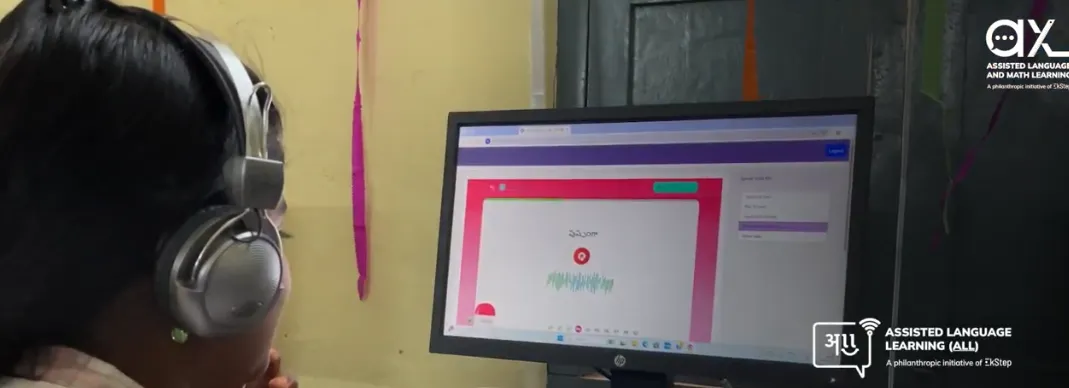
AXL: Assisted Language and Math Learning

India
Education
Implementing Organisation
EkStep Foundation
India, Karnataka, Bengaluru
Implementing Point of Contact
Jagadish Babu
CEO
Contributor of the Impact Story
Carnegie India
Year of implementation
2023
Problem statement
Many primary school students struggle with foundational literacy and numeracy due to varied learning levels, resource constraints, and limited personalised support. Traditional classroom methods often lack the capacity to provide adaptive, practice-based assistance for slow learners. AXL addresses this gap by providing AI-assisted interventions to support language and math learning at scale.
Submission Overview
AXL is an education initiative of the EkStep Foundation, a philanthropic organisation dedicated to improving learning outcomes at population scale through technology and systems reform. AXL develops AI-enabled tools that support foundational literacy and numeracy in government school systems, particularly for students who require additional academic support. Working closely with state education departments and teachers, AXL integrates adaptive learning technologies, speech-based assessment, and personalised practice into classroom instruction. Programmes such as Kalika Deepa in Karnataka demonstrate how AXL’s tools are embedded within public education systems to strengthen classroom learning, engagement, and proficiency. AXL prioritises curriculum alignment, teacher enablement, and responsible AI deployment to ensure equitable access to quality education.
AI Technology Used
Text-to-Speech, Optical Character Recognition, Machine Translation, Adaptive Diagnostic Modelling, Speech Recognition
Key Outcomes
Access & Reach
Knowledge & Skills Impact
User Experience & Satisfaction
Accuracy & Quality Improvement
Inclusion & Equity
AXL offers an AI-assisted approach to foundational literacy and numeracy that adapts to each student's level. This is particularly relevant for under-resourced classrooms where teachers cannot provide individualised attention to slow learners. The platform enables practice-based learning that traditional methods struggle to deliver at scale. Active state programmes in Telangana, Karnataka (Kalika Deepa) and Delhi now cover approximately 5,000 government schools, with roughly 16,000 schools across all implementations and a pipeline extending to seven further states. AXL offers an AI-assisted approach to foundational literacy and numeracy that adapts to each student's level. This is particularly relevant for under-resourced classrooms where teachers cannot provide individualised attention to slow learners. The platform enables practice-based learning that traditional methods struggle to deliver at scale. Active state programmes in Telangana, Karnataka (Kalika Deepa) and Delhi now cover approximately 5,000 government schools, with roughly 16,000 schools across all implementations and a pipeline extending to seven further states. Recent developments include a Foundation Series for pre-literacy learners and an adaptive mathematics engine that diagnoses specific misconceptions rather than simply adjusting difficulty.
Impact Metrics
Number of Schools Benefitted
Baseline Value
Not Applicable Number of Schools and States
Post-Implementation
Approximately 5,000 active schools under state programmes in Telangana, Karnataka and Delhi; approximately 16,000 schools across all implementations, spanning 11 states at active, pilot or pipeline stage Number of Schools and States
Student Learning Improvement (Telangana)
Baseline Value
Not specified Percentage
Post-Implementation
70 % student improvement reported in Telangana state programme
Implementation Context
Indian government school systems, with active state programmes in Telangana, Karnataka (through the Kalika Deepa programme) and Delhi. A further seven states are at pipeline stage through pilots, MoUs or initial discussions: Uttar Pradesh, West Bengal, Assam, Sikkim, Ladakh, Bihar and Tamil Nadu.
Primary government school students, Grades 1 to 5, including a pre-literacy Foundation Series for children below letter-recognition level, engaging both urban and rural student populations.
Key Partnerships
EkStep Foundation; AI4Bharat ; Karnataka, Telangana and Delhi state departments of school education; Centre for Neuroscience, Indian Institute of Science, Bangalore (research partnership); AI Centre of Excellence in Education, IIT Madras
Replicability & Adaptation
- The model is replicable in contexts with basic computing infrastructure
- Adaptation requires localisation of language content, teacher support mechanisms, and alignment with state education goals
Supporting Materials

* The data presented is self-reported by the respective organisations. Readers should consult the original sources for further details.