


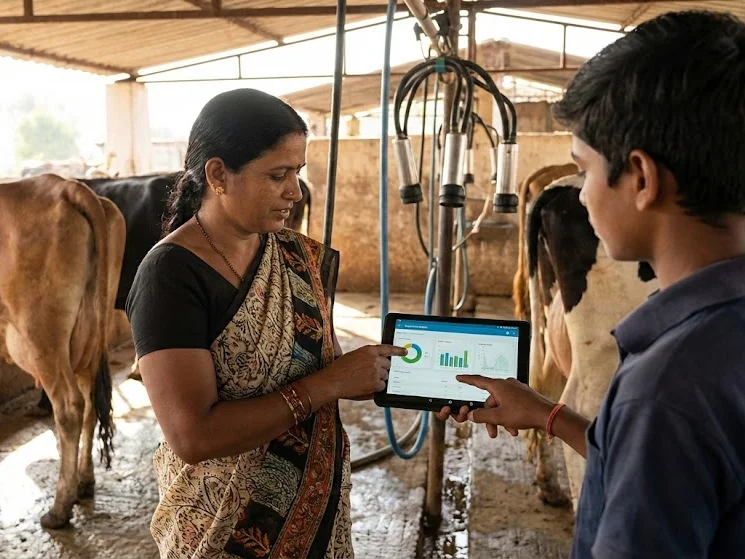
Sarlaben: AI-Powered Dairy Advisory Assistant for 3.6 Million Amul Cooperative Farmers

India
Agriculture
Implementing Organisation
Gujarat Cooperative Milk Marketing Federation (GCMMF) & Amul
India, Gujarat , Anand
Implementing Point of Contact
Jayen Mehta
Managing Director
Contributor of the Impact Story
People+ai
Year of implementation
2026
Problem statement
Dairy farming is highly information-intensive, but smallholder farmers — especially women milk producers in Gujarat — have limited access to timely, personalised guidance on cattle health, feeding, vaccination, breeding, and government subsidy schemes. Veterinary support is available but not continuously accessible. Farmers often make decisions on animal care without access to the accumulated scientific and operational knowledge embedded in Amul's five decades of cooperative data. Sick or underperforming cattle represent direct income loss for women who depend on milk sales as a primary livelihood. Sarlaben was developed to close this advisory gap by giving every farmer 24/7 access to cattle-specific, data-driven guidance in Gujarati via app or phone call.
Submission Overview
Amul launched 'Sarlaben', an AI-powered dairy advisory assistant, to support dairy farmers across Gujarat. Built on decades of cooperative data and integrated with Amul’s digital systems, the platform provides personalised guidance on cattle health, feeding, breeding, vaccination, and government schemes through mobile apps and voice-based access.
AI Technology Used
Key Outcomes
Inclusion & Equity
Access & Reach
Accuracy & Quality Improvement
Knowledge & Skills Impact
Economic Value Creation
Impact Metrics
Description: Scale of underlying data used by AI Baseline: Data existed but was not accessible to farmers in advisory format Post-implementation: AI draws on 200 crore (2 billion) milk procurement transactions; 3 crore (30 million) cattle records; 70 lakh (7 million) artificial inseminations annually Unit: Data records Reported Period: February 2026 (at launch)
Baseline Value
Data existed but was not accessible to farmers in advisory format Data records
Post-Implementation
AI draws on 200 crore (2 billion) milk procurement transactions; 3 crore (30 million) cattle records; 70 lakh (7 million) artificial inseminations annually Data records
Description: Farmer reach via existing app infrastructure. Baseline: Amul Farmer App already downloaded by over 1 million users. Post-implementation: Sarlaben integrated into the app; all existing users gain AI advisory capability; phone-call access extends to feature-phone farmers. SMS video to 2M users; 2,000 outbound calls/day; local campaigns; incentive (free cattle feed if unanswered) Unit: App downloads / Users Reported Period: As of February 2026
Baseline Value
Amul Farmer App already downloaded by over 1 million users. App downloads / Users Reported Period: As of February 2026
Post-Implementation
Sarlaben integrated into the app; all existing users gain AI advisory capability; phone-call access extends to feature-phone farmers. SMS video to 2M users; 2,000 outbound calls/day; local campaigns; incentive (free cattle feed if unanswered) App downloads / Users Reported Period: As of February 2026
Description: Potential beneficiary farmer base. Baseline: 3.6 million farmer-members; 3.5 crore litres of milk collected daily; 24x7 voice-based assistant, (feature phones, Gujarati first). Post-implementation: Sarlaben targets a full member base; actual uptake data to be reported post phase 1 Unit: Farmers Reported Period: Ongoing post-February 2026.
Baseline Value
3.6 million farmer-members; 3.5 crore litres of milk collected daily; 24x7 voice-based assistant, (feature phones, Gujarati first).
Post-Implementation
Sarlaben targets a full member base; actual uptake data to be reported post phase 1 Farmers
Description: Veterinary knowledge coverage. Baseline: 1,500+ vets serving 30 million cattle. Post-implementation: Sarlaben digitises and democratises veterinary knowledge for round-the-clock access. Unit: Cattle covered Reported Period: At launch, February 2026
Baseline Value
1 ,500+ vets serving 30 million cattle.
Post-Implementation
Sarlaben digitises and democratises veterinary knowledge for round-the-clock access. Cattle covered
Implementation Context
Gujarat, India (primary deployment). Accessible to Amul cooperative member farmers across Gujarat's 18,000+ village dairy cooperative societies. Platform also open for general dairying guidance to farmers outside Amul's network. Planned language expansion to cover farmer populations in other Indian states.
Primary: 3.6 million women milk producers who are members of Amul's cooperative network in Gujarat. Secondary: Farmers outside the Amul network seeking general dairy advisory. Population profile: rural, women-led households, varying levels of smartphone literacy; includes feature-phone users reached via voice call interface.
Key Partnerships
EkStep Foundation — AI development partner (built personalized advisory layer using farmer- and cattle-level data); MeitY (Ministry of Electronics and Information Technology) — Government backing and digital infrastructure alignment; ISRO — Satellite imagery for fodder production mapping; Amul's internal veterinary network (1,500+ veterinary doctors) — knowledge and data backbone; Pashudhan livestock management platform — cattle data integration; Automatic Milk Collection System (AMCS) — procurement data integration
Replicability & Adaptation
Replicability Information
Transferable with adjustments. Amul's unique advantage is five decades of structured cooperative data (cattle IDs, milk transactions, vet records). Replication in other contexts requires equivalent data infrastructure or significant investment in building it. The advisory architecture and cooperative delivery model are transferable.
Resources Required
- Technical: AI/NLP models with domain adaptation for animal husbandry; integration with livestock management databases; IVR/phone-call interface for non-smartphone users; multilingual language models.
- Human: Veterinary domain experts for knowledge base validation; cooperative extension workers for ground-level support and trust-building.
- Financial: Infrastructure investment proportional to scale of cooperative data; partnership with a digital development organisation (EkStep model). Data: Minimum viable dataset includes individual cattle records (health, milk yield, breeding history), procurement transactions, and fodder/satellite data.
Adaptation Notes
Organisations replicating this model should:
- Map existing cooperative or livestock management data assets before building — Amul's depth of data is the primary differentiator.
- Anchor the advisory tool to trusted existing farmer interfaces (e.g., an existing app with established user base like Amul Farmer App) rather than launching a standalone product.
- Prioritise the language and device needs of target farmers — in Amul's case, Gujarati + phone-call access were non-negotiable.
- Partner with AI development organisations with experience in contextualised, farmer-level personalisation (EkStep Foundation model).
- Consider expanding from cattle health to market linkages, scheme access, and input procurement as secondary features.
Supporting Materials

* The data presented is self-reported by the respective organisations. Readers should consult the original sources for further details.