


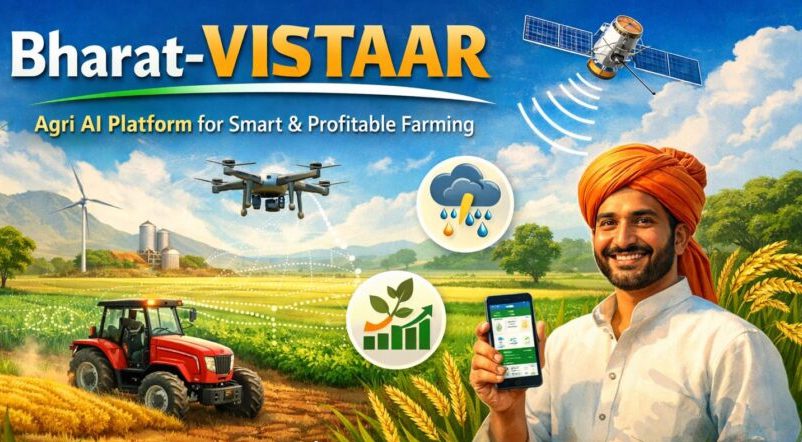
Bharat-VISTAAR (Virtually Integrated System to Access Agricultural Resources

India
Agriculture
Implementing Organisation
Ministry of Agriculture & Farmers' Welfare & The Centre for Open Societal Systems (COSS)
India, National (Pan-India)
Implementing Point of Contact
Jagadish Babu
Chief Operating Officer
Contributor of the Impact Story
People+ai
Year of implementation
2026
Problem statement
Indian agriculture is characterised by fragmentation, information asymmetry, and limited access to timely, reliable advisory services. Over 140 million smallholder farmers rely on periodic extension services or informal networks for decisions on sowing, irrigation, fertilisation, pest control, and scheme access. Agricultural research produced by ICAR and universities rarely reaches ground level. Farmers lack a unified point of access for crop guidance, weather inputs, market intelligence, and government scheme eligibility. Bharat-VISTAAR was designed to bridge this gap by offering a conversational, voice-first, AI-powered interface accessible even to farmers without smartphones or strong digital literacy.
Submission Overview
COSS is a not-for-profit organisation dedicated to driving global societal transformation by facilitating countries to develop their Digital Public Infrastructure (DPI) and advancing the adoption of Digital Public Goods (DPGs) at scale. Headquartered at IIIT Bangalore, COSS is a joint initiative of the EkStep Foundation and IIIT Bangalore. The organisation draws on India’s decade-long experience with digital transformation - including Aadhaar, UPI, and other DPI initiatives - to support countries in building equitable, inclusive digital ecosystems. It has also engaged with governments in Brazil, Morocco, Papua New Guinea, South Africa, and others. Its mission is to improve the lives of 1 billion people globally by 2030 through DPG adoption. The organization contributed to the Bharat-VISTAAR initiative in the context of its broader work at the intersection of AI, public digital infrastructure, and societal impact.
AI Technology Used
Key Outcomes
Inclusion & Equity
Access & Reach
Knowledge & Skills Impact
Efficiency & Productivity
Impact Metrics
Description: Farmer access to unified agricultural advisory. Baseline: No single digital point of access; fragmented extension services. Post-implementation: Single helpline +Y2+Y3
Baseline Value
No single digital point of access; fragmented extension services.
Post-Implementation
Single helpline +Y2+Y3
Description Language accessibility Baseline: English and Hindi only in most digital govt (Ag) platforms. Post-implementation: 2 languages at launch; roadmap to 11 Indian languages Unit: Number of languages. Reported Period: February 2026. Evidence Source: Internal / Government announcement
Baseline Value
English and Hindi only in most digital govt (Ag) platforms.
Post-Implementation
2 languages at launch; roadmap to 11 Indian languages Unit: Number of languages.
Description: Farmer reach target Baseline: ~140 million smallholder farmers with limited real-time advisory access. Post-implementation: Targeting national reach. Farmers Reported Period: 2026 (ongoing). Evidence Source: Internal Monitoring, Independent Evaluation
Baseline Value
~140 million smallholder farmers with limited real-time advisory access.
Post-Implementation
Targeting national reach.
Implementation Context
Pan-India; Phase 1 with national rollout. Platform accessible via toll-free helpline (155261), mobile application, and SMS across all states.
140+ million smallholder farmers across India; focus on rural, low-income, and digitally underserved farmer populations including those relying on feature phones. Particular relevance for farmers in Hindi-speaking states in Phase 1, with planned expansion to 11 Indian languages.
Key Partnerships
Indian Council of Agricultural Research (ICAR) - knowledge backbone; India Meteorological Department (IMD) — weather data; AgriStack — farmer digital identity and data; Mandi price systems — market intelligence; Ministry of Electronics and Information Technology (MeitY) — digital infrastructure support; Krishi Vigyan Kendras (KVKs) and agricultural universities — extension alignment
Replicability & Adaptation
Replicability Information
The DPI-based architecture and voice-first design are replicable. Replication requires localised agricultural knowledge bases, language models, and integration with country-specific agronomy and extension systems.
Resources Required
- Technical: AI/NLP infrastructure, multilingual language models, integration with national agricultural databases (soil, weather, market data), mobile and IVR (phone call) interface.
- Human: Agricultural scientists and domain experts for knowledge base curation; extension officers for ground-level validation.
- Financial: Significant public investment in data infrastructure and helpline operations; aligned with national Digital Agriculture Mission (India allocated ₹2,800+ crore for 2024-26 Digital Agriculture Mission
Adaptation Notes
Countries replicating this model should:
- Build or leverage existing national agricultural databases equivalent to AgriStack.
- Partner with research institutions (e.g., equivalent of ICAR) to ground advisory in verified agronomic knowledge.
- Prioritise voice-first and feature-phone accessible interfaces for rural populations;.
- Invest in language localisation for regional agricultural contexts.
- Align with existing extension systems rather than replacing them
Supporting Materials

* The data presented is self-reported by the respective organisations. Readers should consult the original sources for further details.