


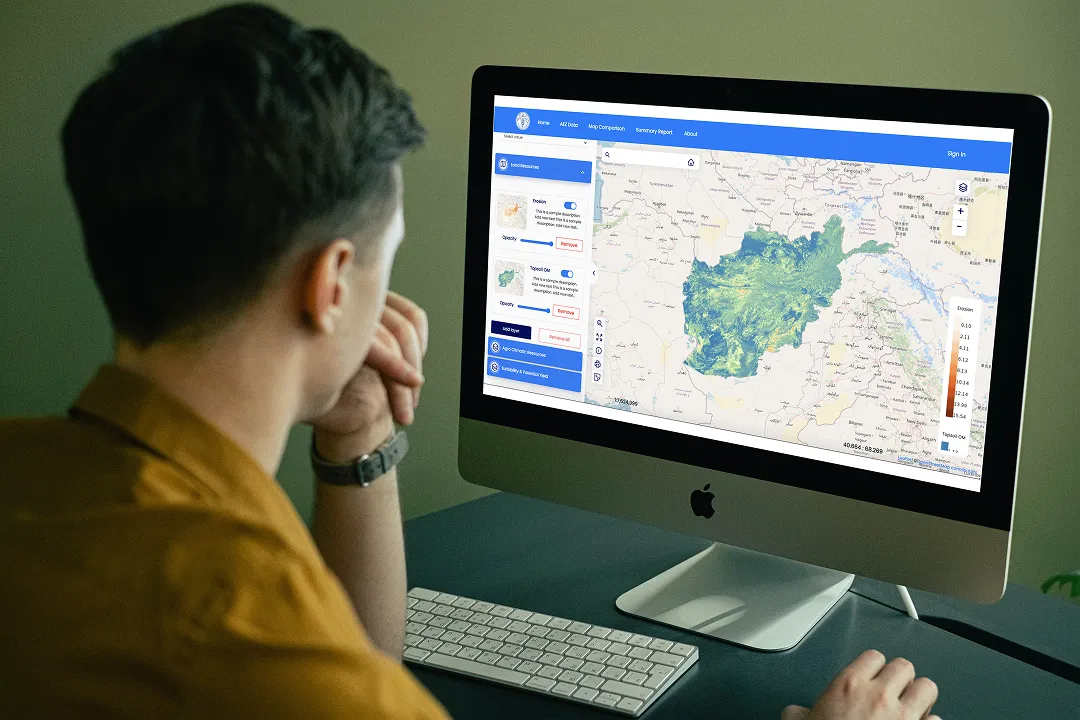
Rootcode FAO System: Advanced Raster Data Processing and Analysis System for Agricultural Decision-Making

Sri Lanka
Agriculture
Implementing Organisation
Rootcode
Sri Lanka, Western Province, Colombo
Implementing Point of Contact
Alagan Mahalingam
Founder and CEO
Contributor of the Impact Story
Carnegie India
Year of implementation
2023
Problem statement
Agricultural decision-makers and food security organisations face significant challenges in processing and analysing large-scale geospatial data for informed policy-making. Traditional methods of integrating spatial information with conventional datasets are time-consuming, error-prone, and often fail to provide the rapid, accurate analysis needed for timely interventions. This results in suboptimal resource allocation, delayed responses to food security threats, and increased costs in agricultural planning and compliance monitoring. The UN FAO and regional organisations needed a system that could transform raw raster data into actionable insights for sustainable development planning.
Submission Overview
Rootcode is a global technology company founded in Sri Lanka, specialising in AI platforms and software solutions for European governments and Fortune 500 companies. With 115+ employees across Sri Lanka, Estonia, and the US, Rootcode has won competitive government contracts in Estonia, Portugal, and Czech Republic, often against major consulting firms like Accenture and IBM. The company holds ISO 9001 and ISO 27001 certifications and has been recognised with multiple awards including the Asia Pacific ICT Awards 2025 (#1 in Asia Pacific). Rootcode also operates the Rootcode Foundation, providing technology education to over 1,000 underprivileged students in Sri Lanka.
AI Technology Used
Remote Sensing Analytics
Key Outcomes
Efficiency & Productivity
Accuracy & Quality Improvement
Access & Reach
Knowledge & Skills Impact
Agricultural use cases often require large-scale geospatial data to be processed in real-time with a high degree of accuracy to make effective decisions. Traditional methods often result in delays that limit timely intervention and involve manual compilation and integration of data. Rootcode’s AI-powered system enables near real-time analysis of satellite and spatial data, replacing workflows that previously took days or weeks. The platform integrates spatial data with conventional datasets, enabling food security planning and resource allocation through useful visualisation, allowing effective planning and crisis response with low operational overheads.
Impact Metrics
Time reduction in processing and analyzing raster data for agricultural decision-making
Baseline Value
Manual processing took days to weeks Days
Post-Implementation
Near real-time analysis of raster data achieved post-implementation Days
Ability to Integrate Spatial Data with Conventional Datasets
Baseline Value
There was limited data integration due to siloed systems System capability
Post-Implementation
Seamless integration with holistic data visualisation was achieved System capability
Implementation Context
Southeast Asia and Afghanistan, in partnership with Geo-Informatics Center, Thailand
The target population is FAO officials and policy makers working on food security and agricultural development across Southeast Asia and Afghanistan.
Key Partnerships
United Nations Food and Agriculture Organization (FAO), Geo-Informatics Center (GIC)
Replicability & Adaptation
- Similar raster data processing systems can be adapted for different geographic regions by incorporating region-specific satellite imagery and agricultural data
- Local calibration of algorithms may be required based on crop types, climate conditions, and available data sources
- Integration with existing national agricultural information systems would enhance adoption
Supporting Materials

* The data presented is self-reported by the respective organisations. Readers should consult the original sources for further details.